In our system of parliamentary democracy, we do not elect a government; we elect a parliament. The government is formed when a group of members of the parliament can demonstrate that they have the support of the majority of the members to carry on a legislative agenda: to govern.
When the government no longer has the support of the parliament, the government falls and is replaced. The creation of a coalition of opposition parties to defeat and replace a sitting government is not illegitimate; it's how our system is meant to operate.
What it is, of course, is highly unusual in Canadian politics. Nothing like this has been done in the memory of most living Canadians. That doesn't make it illegal.
Canadians did not give Harper's Conservatives a mandate to run the country single-handedly. Canadians may be willing to let Harper sit in the driver's seat for a while, but after two elections they sure don't seem willing to let him have the keys on his own. Harper has spent the last three years forming coalitions; in a minority situation, the survival of his government has depended on it. Not one piece of his legislation could have passed the house without at least some opposition members voting along with the government. Harper may not have formed a formal coalition as the opposition has now done, but every piece of government business he presented to the House necessitated the forming of an ad hoc coalition with one of more opposition parties.
Harper's mistake is the age-old mistake of hubris. With Dion a lame-duck leader of the weakened Liberals, Harper believed he could push through with his damaging agenda, using a crisis to push through ideologically-driven economic measures.
Harper's economic statement originally proposed a three-year ban on the right of civil servants to strike, limits on the ability of women to sue for pay equity and eliminated subsidies for political parties. How does denying pay equity for women help stave off the effects of the worldwide economic meltdown? It doesn't, of course. It's just classic neo-conservative tactics -- use every chance to propel your ideological agenda. It's not about the economy, stupid; it's about using the economy to score every little political point you can.
Harper follows every page of the neo-con text book. He says one thing, but does another. Fixed election dates, anyone? He spent two years (and millions of dollars) on an ad campaign deriding Stephan Dion with personal attacks before the election was even called, despite his previous campaign promises on returning civility to politics. He accuses Dion of sharing power with seperatists, yet he and his party suck up to them in Quebec every chance they get. They have to, because that's the only group where he will get any support from in Quebec. His party has a long history of courting with the seperatists; it was Brian Mulroney's inability to control the seperatists MP in his Tory ranks that resulted in the formation of the Bloc.
In his acceptance speech this year, he said we work with the other parties in the House, yet his first economic announcement includes the cutting of party subsidies. How is this going to return civility to the House? Or more importantly, how does this help stimulate the economy when opposition parties have to lay-off low-level party workers during a recession? This is just petty nastiness.
And he lies, of course. He lies when he says that the coalition agreement was not signed in front of Canadian flags because of the presence of the separatist party (a lie - there were two Canadian flags). He lies when says he would never enter deals to govern the country with separatists. He signed a deal with the BQ to do just that in 2004, and his predecessor Stockwell Day arranged one with the BQ in 2000.
When confronted with criticism, he and his lackeys do not confront the issues, instead they issue personalize attacks on the messenger. How many Harper ads did you hear during the last campaign attacked Dion the person, yet how few did you hear actually debating the merits of Dion's proposals and presenting alternatives?
The crisis here is one of a reckless leader over-reaching for his dubious goals. It is a crisis of agenda, not process. You may argue that the Liberal/NDP coalition (with Bloc support) is fraught with dangers, and it is. They have matches and there's a lot of gasoline pooled about. But even that does not make their proposed actions any less legitimate.
And I'll take that over a leader who gives every indication of his intention to burn down the progressive house that we Canadians have spent 141 years building.
Percentage of Canadians who did not vote for Harper's Conservatives in the 2008 election: 62.4%
Showing posts with label canadian politics. Show all posts
Showing posts with label canadian politics. Show all posts
Wednesday, December 03, 2008


Wednesday, June 13, 2007
Enjoy Being Canadian While You Can
The Tyee reports on a behind-the-curtains plan to integrate Canada into the US politcal and financial framework. What's scary is how much as already been done without us even knowing about it. Be worried.

"If the machinations going on in this country regarding so-called "deep integration" were instead a communist conspiracy to take over the country (you will, of course, have to try hard to imagine this) the news media would be blaring the story.
Pundits would pontificate, editorialists would erupt, security forces would be unleashed.
Instead, a virtual conspiracy to make the country disappear through assimilation into the U.S. gets barely a mention.
But news of the scheme -- formally called the Security and Prosperity Partnership of North America (SPP) -- is finally breaking out of the secret chambers of the ruling elite and the federal government. This is both good news and bad. It's good that ordinary citizens are finally getting a glimpse of the betrayal of their country. The news is bad because it reflects just how much of this scheme is already being implemented.
Given the meetings of CEOs and politicians to advance the scheme politically, as well as all that must go into its actual implementation, there is simply too much activity to keep secret."

Friday, April 27, 2007
The Devil and Kyoto
Let's start with the good news, what little there is, and give the devil his due: at least Harper and the Tories have done something on carbon emissions.
Mind you, it's very little and probably far too late, but at least it's something.
The bad news is that our Kyoto commitments will be not be met, in violation of international law, and there is no guarantee that the Tories' targets will result in emissions being reduced anyway.
By using intensity targets instead of hard caps, it will possible for industries to increase their emissions, yet still meet the Tories emission reduction targets. How's that for having it both ways?
And the ultimate kicker is that industries that can prove that they have no way of reducing their emissions, cement factories for instance, don't have to. That makes a lot of sense. I can prove that my industrial waste emissions, which are killing people and the planet, cannot be reduced in any way, therefore I should be allowed to continue to kill people and the planet with impunity. WTF???
The Tories worry that too much emission reduction will damage the economy. I wonder how much the economy will suffer when ocean levels rise in a couple of decades and Canada has a million former-residents of Vancouver as refugees. Of course, that sort of long-term thinking never enters the thoughts of most politicians.
The ultimate irony is that the Kyoto targets are only a start. They are only a small fraction of what needs to be done. Meeting Kyoto is only the beginning: the real hard cuts are yet to come.
If you hear any politician say that we can continue on our merry way and all we need to do change a few light bulbs and drive a little less and everything will be fine, he is woefully ill-informed. Or he is lying.
Vast societal changes are coming. But the politicians, like the rest of us, have their heads in the sand.
Mind you, it's very little and probably far too late, but at least it's something.
The bad news is that our Kyoto commitments will be not be met, in violation of international law, and there is no guarantee that the Tories' targets will result in emissions being reduced anyway.
By using intensity targets instead of hard caps, it will possible for industries to increase their emissions, yet still meet the Tories emission reduction targets. How's that for having it both ways?
And the ultimate kicker is that industries that can prove that they have no way of reducing their emissions, cement factories for instance, don't have to. That makes a lot of sense. I can prove that my industrial waste emissions, which are killing people and the planet, cannot be reduced in any way, therefore I should be allowed to continue to kill people and the planet with impunity. WTF???
The Tories worry that too much emission reduction will damage the economy. I wonder how much the economy will suffer when ocean levels rise in a couple of decades and Canada has a million former-residents of Vancouver as refugees. Of course, that sort of long-term thinking never enters the thoughts of most politicians.
The ultimate irony is that the Kyoto targets are only a start. They are only a small fraction of what needs to be done. Meeting Kyoto is only the beginning: the real hard cuts are yet to come.
If you hear any politician say that we can continue on our merry way and all we need to do change a few light bulbs and drive a little less and everything will be fine, he is woefully ill-informed. Or he is lying.
Vast societal changes are coming. But the politicians, like the rest of us, have their heads in the sand.
Wednesday, March 21, 2007
Harper Pulls a Bush
Prime Minister Harper continues to use plays from "President" Bush's neocon handbook, using "hardball partisan politics."
Under fire from opposition MPs over erroneous statements by Defence Minister Gorodn O'Connor to the House of Commons concerning Afghan detainees, Harper responded by saying, "I can understand the passion that the leader of the Opposition and members of his party feel for Taliban prisoners. I just wish occasionally they would show the same passion for Canadian soldiers."
Needless to say, all the Opposition party leaders are outraged.
Harper is using an old Bush tactic, attacking the and patriotism and character of his criticizers instead of dealing with the criticism, in this case O'Connor's acknowledged misleading of the House of Commons two weeks ago by saying that the Red Cross would keep Canada informed about the condition of prisoners handed over to Afghan officials by Canadian soldiers. Earl er this week, O'Conner apologized to the House, admitting that the Red Cross is under no such obligation.
Harper would rather ignore the fact that a senior member of his cabinet mislead the House, and would rather insult the people who caught him at it.
That's misplaced priorities, and that's classic Bush.
Under fire from opposition MPs over erroneous statements by Defence Minister Gorodn O'Connor to the House of Commons concerning Afghan detainees, Harper responded by saying, "I can understand the passion that the leader of the Opposition and members of his party feel for Taliban prisoners. I just wish occasionally they would show the same passion for Canadian soldiers."
Needless to say, all the Opposition party leaders are outraged.
Harper is using an old Bush tactic, attacking the and patriotism and character of his criticizers instead of dealing with the criticism, in this case O'Connor's acknowledged misleading of the House of Commons two weeks ago by saying that the Red Cross would keep Canada informed about the condition of prisoners handed over to Afghan officials by Canadian soldiers. Earl er this week, O'Conner apologized to the House, admitting that the Red Cross is under no such obligation.
Harper would rather ignore the fact that a senior member of his cabinet mislead the House, and would rather insult the people who caught him at it.
That's misplaced priorities, and that's classic Bush.
Tuesday, March 06, 2007
We're Number One! We Are! Really!
According to this BBC poll, Canada was viewed as having a positive influence in the world by 54% of the respondents, top in the poll. Japan was also viewed as having a positive influence by 54% of the repsondents, but Japan also had a slightly higher number of people who said that it had a negative influence, 20% to Canada's 14% negative influence score, the lowest in the poll.
At the other end, The United States had a postive rating of only 30% and a negative rating of 51%. Only Iran (54%) and Israel (56%) had lower negative scores, with North Korea close behind (48%). Israel also had the lowest postive influence score at 17%.

At the other end, The United States had a postive rating of only 30% and a negative rating of 51%. Only Iran (54%) and Israel (56%) had lower negative scores, with North Korea close behind (48%). Israel also had the lowest postive influence score at 17%.

Wednesday, January 31, 2007
Harper and Kyoto
According to this CBC report, a leaked 2002 letter from current Prime Minister Stephen Harper (then leader of the now-dead Canadian Alliance party) to party supporters called the Kyoto Accord a "socialist scheme" designed to suck money out of rich countries.
Other choice Harper quotes from the letter include:
Harper also says that the accord is based on "tentative and contradictory scientific evidence" and it focuses on carbon dioxide, which is "essential to life."
There is the old notion that most politicians are generally 20 years - a whole generation - behind the general public in discovering the important issues of the day. Who'd've thought that Stephen Harper was a Neanderthal? (Okay, hands down - that was a rhetorical question, dammit!)
With leadership like this, it's a wonder we're not already dead.
Other choice Harper quotes from the letter include:
"We're gearing up now for the biggest struggle our party has faced since you entrusted me with the leadership ... I'm talking about the 'battle of Kyoto' — our campaign to block the job-killing, economy-destroying Kyoto accord.
"Kyoto is essentially a socialist scheme to suck money out of wealth-producing nations.
"We will do everything we can to stop him there, but [Prime Minister Chrétien] might get it passed with the help of the socialists in the NDP and the separatists in the BQ [Bloc Québécois]."
Harper also says that the accord is based on "tentative and contradictory scientific evidence" and it focuses on carbon dioxide, which is "essential to life."
There is the old notion that most politicians are generally 20 years - a whole generation - behind the general public in discovering the important issues of the day. Who'd've thought that Stephen Harper was a Neanderthal? (Okay, hands down - that was a rhetorical question, dammit!)
With leadership like this, it's a wonder we're not already dead.
Friday, November 10, 2006
Liberals Lead Without A Leader
The leaderless Liberal party is outpolling the governing Conservatives and Prime Minister Stephen Harper in every province except Alberta.
What else can you expect from a province that keeps electing Ralph Klein?
What else can you expect from a province that keeps electing Ralph Klein?
Thursday, October 26, 2006
Kissing Kyoto Goodbye
"It's a path which is indeed, globally, quite suicidal. I just look to my grandchildren and their children and say, 'Jesus, the world is going to be a different place, and it's going to be a much less secure place, and much less comfortable place and there's going to be a whole pile of dead people.'"
-- Former Environment Minister David Anderson
Canada is first out of Kyoto, in deed if not in word, with the Conservative government's so-called Clean Air Act which was introduced last week. Prime Minister Harper, saying this country is showing leadership by sending our boys and girls off to die to honour our NATO commitments, doesn't seem able to show leadership by living up to our international environmental commitments. The true north, strong and free, and the biggest per capita polluters on the planet.
While some might argue that the government's slow pace to bring in hard caps is better than nothing, it's really worse than nothing. For starters, Harper is planning three years of consultation with industry before producing any new regulations at all. Hard emissions caps will be introduced until 2025. This lengthy period of inaction is explained away by the old excuse of not wanting to harm the economy.
This is madness. There will be no economy by the mid-21st century without immediate action on climate control now.
How hard is to say to industry , "2006 is the limit. Next year, you cannot pollute anymore than you did this year. And the year after, you're going to start bringing that down."
What others are saying:
CTV
CNN
CBC
Garth Turner
Green Party
Environmental Defence
Sierra Club
earthtimes
-- Former Environment Minister David Anderson
Canada is first out of Kyoto, in deed if not in word, with the Conservative government's so-called Clean Air Act which was introduced last week. Prime Minister Harper, saying this country is showing leadership by sending our boys and girls off to die to honour our NATO commitments, doesn't seem able to show leadership by living up to our international environmental commitments. The true north, strong and free, and the biggest per capita polluters on the planet.
While some might argue that the government's slow pace to bring in hard caps is better than nothing, it's really worse than nothing. For starters, Harper is planning three years of consultation with industry before producing any new regulations at all. Hard emissions caps will be introduced until 2025. This lengthy period of inaction is explained away by the old excuse of not wanting to harm the economy.
This is madness. There will be no economy by the mid-21st century without immediate action on climate control now.
How hard is to say to industry , "2006 is the limit. Next year, you cannot pollute anymore than you did this year. And the year after, you're going to start bringing that down."
What others are saying:
CTV
CNN
CBC
Garth Turner
Green Party
Environmental Defence
Sierra Club
earthtimes
Tuesday, October 17, 2006
Soldiers' deaths in Afghanistan the price of leadership: Harper
According to this CBC article, Prime Minister Stephen Harper says the toll of Canadian soldiers killed in Afghanistan is the price Canada is paying for playing a leadership role in world affairs.
Whether you agree with the mission of our soldiers in Afghanistan or not, the one thing they are not there for is to soothe the ego of our nation and to convince our Prime Minister and ourselves that we are a major player on the world stage. If Harper's ego needs placating, he should find a better way of dealing with it.
If that really is why we are spilling our blood overseas, then they should come home right now.
"We see just how proud Canadians are of their soldiers and their families and we have also seen how difficult it is to bear the sorrows of their losses. But, ladies and gentlemen, that is the price of leadership in the world," Harper told the audience.
Whether you agree with the mission of our soldiers in Afghanistan or not, the one thing they are not there for is to soothe the ego of our nation and to convince our Prime Minister and ourselves that we are a major player on the world stage. If Harper's ego needs placating, he should find a better way of dealing with it.
If that really is why we are spilling our blood overseas, then they should come home right now.
Wednesday, July 26, 2006
Blame the Victim
So far, Israeli shelling in Lebanon has killed eight Canadian citizens, including one UN peacekeeper.
And what does our Prime Minister have to say? Not much, other than he's sure it was an accident and that everyone's really really sorry.
Hurling ordnance into cities is never an accident.
Talk about blaming the victims....
And what does our Prime Minister have to say? Not much, other than he's sure it was an accident and that everyone's really really sorry.
Hurling ordnance into cities is never an accident.
Talk about blaming the victims....
Tuesday, June 06, 2006
The Rabble are Roused
In light of the arrests of some apparent Muslim extremists who were plotting to bomb targets in Ontario, it shouldn't be surprising that I heard someone on an open line radio show call for summary convictions of alleged terrorists. "Keep the lawyers out of it. And none of this civil liberties crap, either," the caller shouted. "We know they did it. Lock them away!"
I was almost positive that next he would demand that all Muslims in Canada be interred in large camps (not next to his house, of course).
Clearly, the rabble are roused.
(And it seems that the RCMP itself sold the fertilizer to the would-be bombers, at least according to this story that the Canadian media hasn't reported yet.
Addendum: The CBC got around to mentioning the RCMP sting in its coverage on June 7.)
I was almost positive that next he would demand that all Muslims in Canada be interred in large camps (not next to his house, of course).
Clearly, the rabble are roused.
(And it seems that the RCMP itself sold the fertilizer to the would-be bombers, at least according to this story that the Canadian media hasn't reported yet.
Addendum: The CBC got around to mentioning the RCMP sting in its coverage on June 7.)
Monday, February 06, 2006
Election Denouement '06: Meet The New Boss, Same as The Old Boss
With his first act as Prime Minister, Stephen Harper demonstrated that he can play the political game as well as anyone, and his high-minded campaign of integrity, honest government and accountably were as worthless as Chretien's promise to remove the GST.
In other words, he said anything to be elected, and now that's he won, the real Harper agenda will now be revealed.
First, MP David Emerson, re-elected a scant two weeks ago as a Liberal, crossed the floor to join the Conservative cabinet as the Minister of International Trade, with responsibilities for the Vancouver Olympics. Emerson, who had vowed on election night to become the new prime minister's "worst nightmare", does not understand what the fuss is about. His Conservative opponent finished a distant third in his riding; clearly his constituents what wanted a Liberal representing them.
And after all the Tory's boo-hooing when Belinda Stronach crossed the floor, and the cries of anger and outrage when the Liberals were apparently caught trolling for other Tory MPs in the last house, one would have thought Harper would heeded the calls from his party and enacted legislation requiring members that cross the floor to win their seats back in a by-election, rather than trolling for Liberals who value bigger pay cheques over serving their constituents. And he want after a Liberal! You remember them, those corrupt and decadent crooks that Harper just spent the last eight weeks telling us we couldn't trust.
Harper also appointed Michael Fortier to the position of Minister of Public Works and government Services. Fortier was the Conservative campaign co-chair in 2004 and 2006, and co-chair of Harper's leadership campaign in 2006. He lost a bid for the Conservative leadership in the 1990s, and lost a bid to win a seat in the 2000 federal election. While the PM has the right to name anyone he wants to cabinet, traditionally it has been a sitting MP, and if the person chosen is not an MP (as in Fortier's case), the new cabinet member usually runs in a by-election at the earliest opportunity. This will not happen this time; Fortier is being appointed to the Senate, where he will sit until the next election, when he will run.
In other words, Harper's first political appointee is a Conservative party hack who will sit in the Senate and Cabinet. Patronage lives! Worse, Fortier won't have to take questions in The House because he's not a member -- so much for accountability!
And finally, Stockwell Day was given the Public Safety portfolio. While giving Day any form of responsibility is a disaster waiting to happen, surely Day would have preferred some sort of Recreation portfolio. He's clearly a man who loves water sports.
In other words, he said anything to be elected, and now that's he won, the real Harper agenda will now be revealed.
First, MP David Emerson, re-elected a scant two weeks ago as a Liberal, crossed the floor to join the Conservative cabinet as the Minister of International Trade, with responsibilities for the Vancouver Olympics. Emerson, who had vowed on election night to become the new prime minister's "worst nightmare", does not understand what the fuss is about. His Conservative opponent finished a distant third in his riding; clearly his constituents what wanted a Liberal representing them.
And after all the Tory's boo-hooing when Belinda Stronach crossed the floor, and the cries of anger and outrage when the Liberals were apparently caught trolling for other Tory MPs in the last house, one would have thought Harper would heeded the calls from his party and enacted legislation requiring members that cross the floor to win their seats back in a by-election, rather than trolling for Liberals who value bigger pay cheques over serving their constituents. And he want after a Liberal! You remember them, those corrupt and decadent crooks that Harper just spent the last eight weeks telling us we couldn't trust.
Harper also appointed Michael Fortier to the position of Minister of Public Works and government Services. Fortier was the Conservative campaign co-chair in 2004 and 2006, and co-chair of Harper's leadership campaign in 2006. He lost a bid for the Conservative leadership in the 1990s, and lost a bid to win a seat in the 2000 federal election. While the PM has the right to name anyone he wants to cabinet, traditionally it has been a sitting MP, and if the person chosen is not an MP (as in Fortier's case), the new cabinet member usually runs in a by-election at the earliest opportunity. This will not happen this time; Fortier is being appointed to the Senate, where he will sit until the next election, when he will run.
In other words, Harper's first political appointee is a Conservative party hack who will sit in the Senate and Cabinet. Patronage lives! Worse, Fortier won't have to take questions in The House because he's not a member -- so much for accountability!
And finally, Stockwell Day was given the Public Safety portfolio. While giving Day any form of responsibility is a disaster waiting to happen, surely Day would have preferred some sort of Recreation portfolio. He's clearly a man who loves water sports.
Tuesday, January 24, 2006
Election Watch '06: Swing to the Right
Stephen Harper should enjoy his moment in the sun. For a guy who’s the next Prime Minister, his government is not in a good spot.
His minority is more tenuous than the previous Liberal government. Consider that Harper’s Conservatives won fewer seats than Martin’s Liberals won in the previous election. Clearly, Harper was hoping for a majority and major breakthroughs in Ontario and Quebec. Heck, he did worse than even I thought he would. While there was some progress for them in Quebec, the Liberals held a lot of their ground in Ontario, winning the popular vote there and denying Harper his majority.
In fact the Conservatives won no seats in the country’s three biggest urban centers, Montreal, Toronto and Vancouver. There’s a decidedly urban/rural split to the Conservative vote. Could this be the start of a deep American-style polarization?
The Liberals showed surprising strength considering they ran a bad campaign and were plagued by scandals. While they suffered in Quebec, they fared better than expected. And thanks to Martin’s resignation, the Liberals will have a new leader facing Harper, possibly making Harper look like yesterday’s news.
The Bloc suffered the most. Expecting to do well, they lost seats and votes. Worse for them, the Tories established themselves as a federalist alternative in Quebec, and with the defeat of the Liberals, the Bloc’s biggest campaign issues, the Liberal party scandals in Quebec, are now off the table.
Even the NDP had some bad news to go with their good showing. Despite gaining a number of seats, they fell two seats short of holding the balance of power.
Where can Harper hope to gain support in the inevitable 2007 election? He won the West; the only place he can gain support is in Ontario and Quebec, and when he starts sucking up to Central Canada, he’ll lose the West. It’s a time-honoured Tory tradition. As Hugh Segal noted on the CBC last night, “When the Liberals are in power, the West votes Conservative. When the Conservatives are in power, the West forms a new party.” Both the Reform and the Bloc Québécois were born out of the self-destruction of the last Conservative government. (And let’s also remember that the last Conservative government, possibly the most corrupt government in Canadian history, ran, like Harper, on being fiscally responsible and promptly had a decade’s worth of the largest deficits in this country has ever seen. But I digress.)
Stephen Harper could be the 21st century version of Joe Clark, a brief Tory minority while the Liberals re-invent themselves. In order to win central Canada, he will have to stick to Ontario-friendly progressive issues (whatever few the Tories have) and abandon (or postpone) the more contentious right wing nut case items of his agenda. Even if Harper wins a majority next time, his days are numbered. He will continue to pander to central Canada as he must to maintain power, the West will feel alienated and the Conservative coalition will implode like it always does, setting the stage for another generation of Liberal rule. For good or ill, it is the natural order of things.
And Harper isn't helping himself by saying things like he “will start rebuilding this country.” Memo to the PM: the country isn't broken.
If Harper thinks he has a mandate for massive social change, he is woefully mistaken. He barely has a mandate to change the stationary.
Obviously, Canadians were weary of giving Harper a full mandate. They remember that if Harper had been PM three years ago, we’d be trapped in a dumb and awful war.
Canadians wanted to spank the Liberals. And they did. They also did not want to give Harper and his neo-con cronies free reign to run the country. And they didn’t.
There’s not a lot of good news to go around after last night’s election. Perhaps the worst news of all is that Stockwell Day might actually be prime material for a cabinet post.
His minority is more tenuous than the previous Liberal government. Consider that Harper’s Conservatives won fewer seats than Martin’s Liberals won in the previous election. Clearly, Harper was hoping for a majority and major breakthroughs in Ontario and Quebec. Heck, he did worse than even I thought he would. While there was some progress for them in Quebec, the Liberals held a lot of their ground in Ontario, winning the popular vote there and denying Harper his majority.
In fact the Conservatives won no seats in the country’s three biggest urban centers, Montreal, Toronto and Vancouver. There’s a decidedly urban/rural split to the Conservative vote. Could this be the start of a deep American-style polarization?
The Liberals showed surprising strength considering they ran a bad campaign and were plagued by scandals. While they suffered in Quebec, they fared better than expected. And thanks to Martin’s resignation, the Liberals will have a new leader facing Harper, possibly making Harper look like yesterday’s news.
The Bloc suffered the most. Expecting to do well, they lost seats and votes. Worse for them, the Tories established themselves as a federalist alternative in Quebec, and with the defeat of the Liberals, the Bloc’s biggest campaign issues, the Liberal party scandals in Quebec, are now off the table.
Even the NDP had some bad news to go with their good showing. Despite gaining a number of seats, they fell two seats short of holding the balance of power.
Where can Harper hope to gain support in the inevitable 2007 election? He won the West; the only place he can gain support is in Ontario and Quebec, and when he starts sucking up to Central Canada, he’ll lose the West. It’s a time-honoured Tory tradition. As Hugh Segal noted on the CBC last night, “When the Liberals are in power, the West votes Conservative. When the Conservatives are in power, the West forms a new party.” Both the Reform and the Bloc Québécois were born out of the self-destruction of the last Conservative government. (And let’s also remember that the last Conservative government, possibly the most corrupt government in Canadian history, ran, like Harper, on being fiscally responsible and promptly had a decade’s worth of the largest deficits in this country has ever seen. But I digress.)
Stephen Harper could be the 21st century version of Joe Clark, a brief Tory minority while the Liberals re-invent themselves. In order to win central Canada, he will have to stick to Ontario-friendly progressive issues (whatever few the Tories have) and abandon (or postpone) the more contentious right wing nut case items of his agenda. Even if Harper wins a majority next time, his days are numbered. He will continue to pander to central Canada as he must to maintain power, the West will feel alienated and the Conservative coalition will implode like it always does, setting the stage for another generation of Liberal rule. For good or ill, it is the natural order of things.
And Harper isn't helping himself by saying things like he “will start rebuilding this country.” Memo to the PM: the country isn't broken.
If Harper thinks he has a mandate for massive social change, he is woefully mistaken. He barely has a mandate to change the stationary.
Obviously, Canadians were weary of giving Harper a full mandate. They remember that if Harper had been PM three years ago, we’d be trapped in a dumb and awful war.
Canadians wanted to spank the Liberals. And they did. They also did not want to give Harper and his neo-con cronies free reign to run the country. And they didn’t.
There’s not a lot of good news to go around after last night’s election. Perhaps the worst news of all is that Stockwell Day might actually be prime material for a cabinet post.
Monday, January 23, 2006
Election Watch '06: Rep by Pop vs First Past the Post
If Canada had a 100% Rep by Pop electoral system, tonight's election results would have looked something like this:
Conservative:
124 seats (actual results) vs 111 seats (rep by pop)
Liberals:
103 seats (actual results) vs 92 seats (rep by pop)
Bloc Québécois:
51 seats (actual results) vs 32 seats (rep by pop)
NDP:
29 seats (actual results) vs 59 seats (rep by pop)
Green:
0 seats (actual results) vs 14 seats (rep by pop)
Conservative:
124 seats (actual results) vs 111 seats (rep by pop)
Liberals:
103 seats (actual results) vs 92 seats (rep by pop)
Bloc Québécois:
51 seats (actual results) vs 32 seats (rep by pop)
NDP:
29 seats (actual results) vs 59 seats (rep by pop)
Green:
0 seats (actual results) vs 14 seats (rep by pop)
Election Watch '06: John's Guide To Electoral Reform
After watching all the Tweedledums and Tweedledumbers lo these last few weeks, I've concluded that Canada clearly needs some electoral reforms. To wit, I humbly offer these suggestions:
1. Whoever Wants to Be Prime Minister Should Be Automatically Barred From Seeking the Office
Clearly, the power associated with the office of a national leader attracts the wrong kind of people. One has to only look at our southerly neighbor to see the ultimate example.
Anyone who actually desires the office of Prime Minister is clearly not the sort of person we want running the country. As the famous philosopher Herman once noted: "The people capable of running the country are too smart to get into politics."
(And this goes along with the mood of most voters in the country. Very few actually want any of the current party leaders to be Prime Minister; either they feel they are left with little choice and must choose the lesser of four evils, or they are not voting for one party as they are voting against another one. I think we have to go back to the heady days of Trudeaumania to find the last time the Canadian populace was genuinely moved to vote for someone.)
2. MPs Should Be Chosen at Random from the General Population
To carry things one step further, anyone wants to be an MP should be barred from office. But then how would we choose our MPs? Via lottery. One citizen would be chosen at random from each riding.
This has the immediate benefit of a House of Commons that more closely represents and reflects the views of the national population.
For example: if 85% of Canadians are against the war in Iraq, it should work out that roughly 85% of our randomly-chosen MPs would be against the war.
If 52% of our population is female, then 52% of our MPs would be female.
If 4% of Canadians are lawyers, then the new House would only have 4% lawyers (as opposed to the 80% it seems we have now).
Parliament would resemble more of a municipal council or Territorial legislature, where various groups may form alliances for specific issues and votes, and a different set of alliances for a different set of issues. All votes would be free votes; there would no parties so no reason to vote along party lines.
Much like how the position of Speaker of the House is voted on by MPs, they would now also select MPs for Cabinet positions, including Prime Minister. (A single mother with two kids would be an excellent choice for finance minister. She would know how to balance the budget, as opposed to a millionaire business man who's so removed from real life that he's never in his life had to account for every cent. But I digress.)
1. Whoever Wants to Be Prime Minister Should Be Automatically Barred From Seeking the Office
Clearly, the power associated with the office of a national leader attracts the wrong kind of people. One has to only look at our southerly neighbor to see the ultimate example.
Anyone who actually desires the office of Prime Minister is clearly not the sort of person we want running the country. As the famous philosopher Herman once noted: "The people capable of running the country are too smart to get into politics."
(And this goes along with the mood of most voters in the country. Very few actually want any of the current party leaders to be Prime Minister; either they feel they are left with little choice and must choose the lesser of four evils, or they are not voting for one party as they are voting against another one. I think we have to go back to the heady days of Trudeaumania to find the last time the Canadian populace was genuinely moved to vote for someone.)
2. MPs Should Be Chosen at Random from the General Population
To carry things one step further, anyone wants to be an MP should be barred from office. But then how would we choose our MPs? Via lottery. One citizen would be chosen at random from each riding.
This has the immediate benefit of a House of Commons that more closely represents and reflects the views of the national population.
For example: if 85% of Canadians are against the war in Iraq, it should work out that roughly 85% of our randomly-chosen MPs would be against the war.
If 52% of our population is female, then 52% of our MPs would be female.
If 4% of Canadians are lawyers, then the new House would only have 4% lawyers (as opposed to the 80% it seems we have now).
Parliament would resemble more of a municipal council or Territorial legislature, where various groups may form alliances for specific issues and votes, and a different set of alliances for a different set of issues. All votes would be free votes; there would no parties so no reason to vote along party lines.
Much like how the position of Speaker of the House is voted on by MPs, they would now also select MPs for Cabinet positions, including Prime Minister. (A single mother with two kids would be an excellent choice for finance minister. She would know how to balance the budget, as opposed to a millionaire business man who's so removed from real life that he's never in his life had to account for every cent. But I digress.)
Tuesday, January 17, 2006
Election Watch '06: Highly Illogical
Not that I have any burning desire to continue to poke fun at Stephen Harper, but what the heck.
A canada.com story points out that apparently Harper is a huge Trekkie (scroll down to the second half of the article).
"Like, huge," says a source. "And it has to be the classic series, from the 1960s - none of that Next Generation, Deep Space Nine crap." Okay, I'll give Harper a point for being a fan of "real" Trek.
How true this really is I don't know, but it readily sets up the tried and true "let's compare the candidates to Star Trek characters" joke.
Paul Martin is Scotty. Clearly, he's always whining about needing more power, but he's also trying his damnedest to keep his wee bairns flying. Unfortunately for him, it seems that the good ship Liberalprise is on it's last legs, no thanks to the evil Klingon, Commander K'Gomery.
Jack Layton is McCoy. He has a cure for everything that ails you, and most of them are just good old fashioned horse sense. He's always muttering that the rest of the crew don't follow his advice. He is always speaking the truth from the heart, and as always, no one listens.
Gilles Duceppe is Captain Kirk. Which makes sense in a way as Duceppe wants to fly his ship his way, damn Starfleet and its blasted regulations. He's not going to listen to some blasted bureaucrats from across the galaxy tell him what to do. He's going to take his ship and fly on a seperate course.
Finally, Harper is unemotional, his smile is forced, and he speaks in a monotone. His logic often fails him at critical plot points. Obviously, he is Spock. He even has the same haircut.
A canada.com story points out that apparently Harper is a huge Trekkie (scroll down to the second half of the article).
"Like, huge," says a source. "And it has to be the classic series, from the 1960s - none of that Next Generation, Deep Space Nine crap." Okay, I'll give Harper a point for being a fan of "real" Trek.
How true this really is I don't know, but it readily sets up the tried and true "let's compare the candidates to Star Trek characters" joke.
Paul Martin is Scotty. Clearly, he's always whining about needing more power, but he's also trying his damnedest to keep his wee bairns flying. Unfortunately for him, it seems that the good ship Liberalprise is on it's last legs, no thanks to the evil Klingon, Commander K'Gomery.
Jack Layton is McCoy. He has a cure for everything that ails you, and most of them are just good old fashioned horse sense. He's always muttering that the rest of the crew don't follow his advice. He is always speaking the truth from the heart, and as always, no one listens.
Gilles Duceppe is Captain Kirk. Which makes sense in a way as Duceppe wants to fly his ship his way, damn Starfleet and its blasted regulations. He's not going to listen to some blasted bureaucrats from across the galaxy tell him what to do. He's going to take his ship and fly on a seperate course.
Finally, Harper is unemotional, his smile is forced, and he speaks in a monotone. His logic often fails him at critical plot points. Obviously, he is Spock. He even has the same haircut.
Thursday, January 12, 2006
Election Watch '06: Candidate Dump
The Tories became the first party to dump a candidate after it was revealed that a BC candidate was facing smuggling charges after allegedly smuggling a car and 112 bottles of booze across the border in 2004. Derek Zeisman will have to sit as independent should he be elected. This could be a sign of things to come as Harper and the Tories edge towards a majority in the polls. The last Tory government under Brian Mulroney was rife with corruption and resignations.
On the other hand, this is the first real glitch in the well-run Tory campaign. The Liberals are panicking; anytime a Prime Minister announces a major campaign plank like eliminating the constitutional Notwithstanding clause (and does it so suddenly that it doesn't even make it into the party's election platform), you know that he thinks he's spending his last days at 24 Sussex. Clearly, Martin is trying to insinuate that Harper has a secret agenda against same-sex marriage, abortion, gay rights and other progressive issues. It wouldn't surprise me at all if Harper did, but Harper, from his perspective, has had the good sense to keep his mouth shut and the good luck that his candidates have done the same thing.
And in a bit of surprise, Mario Dumont (head of the provincial Action démocratique du Québec party) advised voters not to vote for the federal Bloc Québécois). Dumont will not recommend a federal party to vote for, but did say he will vote Conservative. The real surprise will be when Harper gives Dumont a cabinet post. Golly, yes, what a surprise that will be.
I'm sure Jack Layton said or did something this week, too. But no one's listening.
On the other hand, this is the first real glitch in the well-run Tory campaign. The Liberals are panicking; anytime a Prime Minister announces a major campaign plank like eliminating the constitutional Notwithstanding clause (and does it so suddenly that it doesn't even make it into the party's election platform), you know that he thinks he's spending his last days at 24 Sussex. Clearly, Martin is trying to insinuate that Harper has a secret agenda against same-sex marriage, abortion, gay rights and other progressive issues. It wouldn't surprise me at all if Harper did, but Harper, from his perspective, has had the good sense to keep his mouth shut and the good luck that his candidates have done the same thing.
And in a bit of surprise, Mario Dumont (head of the provincial Action démocratique du Québec party) advised voters not to vote for the federal Bloc Québécois). Dumont will not recommend a federal party to vote for, but did say he will vote Conservative. The real surprise will be when Harper gives Dumont a cabinet post. Golly, yes, what a surprise that will be.
I'm sure Jack Layton said or did something this week, too. But no one's listening.
Monday, January 09, 2006
Election Watch '06: Playing Your Cards Right (or Left)
Somehow I've gotten myself on the NDP's emailing list. While normally I instantly delete any political email I get, I opened this latest one and lo and behold found this little gem just in time for tonight's debate.

(I should note for the record that no political party has tried to contact me personally, apart from a pre-recorded phone call from Dr. Keith Martin, my Liberal MP. And with the NSA probably listening in, I hung up in a hurry.)
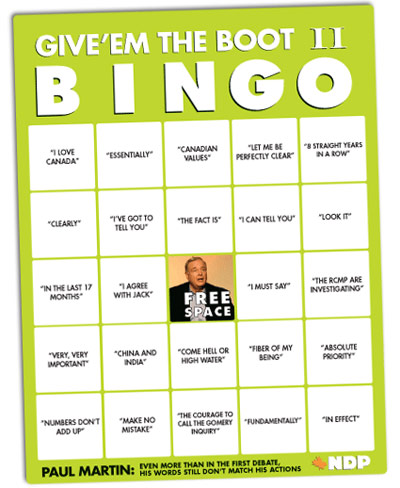
(I should note for the record that no political party has tried to contact me personally, apart from a pre-recorded phone call from Dr. Keith Martin, my Liberal MP. And with the NSA probably listening in, I hung up in a hurry.)
Monday, December 19, 2005
Election Watch '06: A Modest Tax Proposal
There's been a lot of talk in this campaign about cutting the GST and/or cutting Income Tax. Which is fairer? Which helps out low and middle income Canadians the most?
Let me offer my own modest tax proposal -- let's scrap income tax and raise the GST.
Now before anyone calls the looney tuner on me, consider these numbers:
Canadian Government Fiscal 2004 Revenue
GST $28,200,000,000
Income Tax $84,800,000,000
Corporate Tax $27,400,000,000
Note that the GST revenue is almost exactly one third the amount of income tax revenue. So scrapping income tax and raising the GST from 7% to 28% would be revenue neutral.
Yes, 28% is a whopping tax to spend on purchases, but on the other hand there would no income tax deductions off my paycheque. For me personally, that's a savings of around $350 a month. Suddenly, my idea doesn't seem so wacky now, does it?
The GST is strictly a voluntary tax. It automatically taxes an individual based on the taxpayer's ability to pay. For instance:
- a rich person might spend $4000 on a wide-screen HD TV. That's $1120 in tax.
- a middle-class person might spend $1500 on an LCD TV. $420 in tax.
- a lower-income person might spend $500 on the last of the tube TVs. $140 in tax.
Clearly, there are some problems with my idea. Low-income Canadians who pay little or no income tax are not going to benefit from this scheme, so some sort of equalizing payment would have to be developed.
And rich people, some of whom will do anything to avoid paying taxes, will undoubtedly try to import goods from other countries to avoid the new GST.
But in fact, higher income earners should love the new GST. The higher the income bracket, the bigger the income tax savings.
And imagine the other savings. Imagine a vastly downsized CCRA, not spending money to track, compile and check tax returns.
No more income tax audits, and no more income tax forms. No more loopholes for smart accountants to exploit.
I think there's something here. Paul, Stephen, Jack... any comments?
Let me offer my own modest tax proposal -- let's scrap income tax and raise the GST.
Now before anyone calls the looney tuner on me, consider these numbers:
Canadian Government Fiscal 2004 Revenue
GST $28,200,000,000
Income Tax $84,800,000,000
Corporate Tax $27,400,000,000
Note that the GST revenue is almost exactly one third the amount of income tax revenue. So scrapping income tax and raising the GST from 7% to 28% would be revenue neutral.
Yes, 28% is a whopping tax to spend on purchases, but on the other hand there would no income tax deductions off my paycheque. For me personally, that's a savings of around $350 a month. Suddenly, my idea doesn't seem so wacky now, does it?
The GST is strictly a voluntary tax. It automatically taxes an individual based on the taxpayer's ability to pay. For instance:
- a rich person might spend $4000 on a wide-screen HD TV. That's $1120 in tax.
- a middle-class person might spend $1500 on an LCD TV. $420 in tax.
- a lower-income person might spend $500 on the last of the tube TVs. $140 in tax.
Clearly, there are some problems with my idea. Low-income Canadians who pay little or no income tax are not going to benefit from this scheme, so some sort of equalizing payment would have to be developed.
And rich people, some of whom will do anything to avoid paying taxes, will undoubtedly try to import goods from other countries to avoid the new GST.
But in fact, higher income earners should love the new GST. The higher the income bracket, the bigger the income tax savings.
And imagine the other savings. Imagine a vastly downsized CCRA, not spending money to track, compile and check tax returns.
No more income tax audits, and no more income tax forms. No more loopholes for smart accountants to exploit.
I think there's something here. Paul, Stephen, Jack... any comments?
Saturday, December 17, 2005
Election Watch '06: Debate #1
Caught a bit of last night's debate.
Gilles Duceppe, as usual, was the most polished and made the most sense.
And if he didn't have this totally bizarre fixation on breaking up a perfectly good country, he'd probably make a great Prime Minister.
Gilles Duceppe, as usual, was the most polished and made the most sense.
And if he didn't have this totally bizarre fixation on breaking up a perfectly good country, he'd probably make a great Prime Minister.
Subscribe to:
Posts (Atom)